
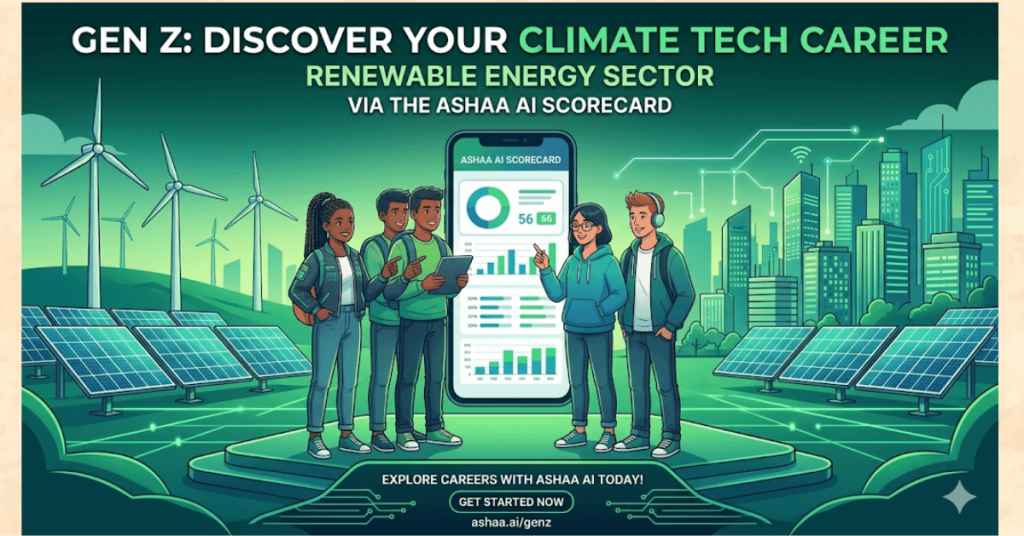
Climate change is not a distant problem for future generations; it is already reshaping economies, cities, and career paths today. For Gen Z, this crisis is also a once-in-a-century opportunity to build meaningful, future-proof careers in the green economy. From solar energy parks in Tamil Nadu to climate fintech hubs in Singapore, climate tech roles are now real, growing, and increasingly well-paid. This blog will show you why climate tech is booming, which roles you should know, and how to start building your own climate career right now.
1. Why Climate Tech Is Booming Right Now?
Governments and companies across Asia have committed to ambitious net-zero and decarbonisation targets, and they cannot reach them without a new generation of skilled professionals. India has announced a net-zero target for 2070, China leads global solar manufacturing, and Southeast Asian countries are pouring billions into renewables, resilient infrastructure, and low-carbon transport. Behind every solar park, climate policy, and green bond is a team of people designing, building, and managing solutions—yet many of these roles are still hard to fill because the talent pipeline is lagging behind climate ambition.
Climate tech is much broader than “just” climate science or environmental engineering.
• Clean energy needs engineers, project managers, grid planners, and supply chain specialists.
• Climate policy needs analysts, negotiators, and data scientists who can translate science into laws and regulations.
• Sustainable agriculture needs agronomists, food systems designers, and tech innovators who can boost yields while cutting emissions.
• Green finance needs investment analysts who understand carbon markets, ESG frameworks, and sustainable investing.
If you are not a science student, do not count yourself out. The climate sector also needs economists, designers, UX specialists, storytellers, lawyers, and communicators who can make complex ideas understandable and drive real change.
2. Three Climate Tech Careers to Know
Renewable Energy Project Manager
A Renewable Energy Project Manager plans and oversees the development of solar farms, wind projects, rooftop systems, and microgrids from concept to completion. They coordinate engineers, contractors, local communities, and regulators to ensure projects are delivered on time, within budget, and with minimal environmental and social risk. Demand for such roles is high in countries like India, Vietnam, Indonesia, and the Philippines as they rapidly add renewable capacity.
To move toward this path, you can combine a basic engineering or science foundation with project management skills. Internships with solar or wind developers, infrastructure firms, or energy utilities can give you exposure to real project timelines and stakeholder management. Certifications in project management and basic training in renewable energy systems will make your profile stand out.
Carbon Market Analyst
A Carbon Market Analyst works in the fast-growing world of carbon credits, emissions trading, and corporate net-zero strategies. Their job is to evaluate carbon offset projects, analyse carbon pricing trends, and help companies design credible decarbonisation roadmaps that mix real emissions cuts with high-quality offsets. These roles are especially hot in financial hubs such as Singapore, Mumbai, and Hong Kong, where climate finance and carbon services are expanding.
You do not need to start as a carbon expert. A background in finance, economics, statistics, or business—combined with courses on climate policy and carbon markets—can be enough for entry-level roles. Reading real carbon project documents, exploring standards like the major carbon registries, and following climate finance news will help you speak the language of this emerging field.
Sustainable Product Designer
Sustainable Product Designers reimagine everyday products—from packaging and electronics to clothing and furniture—so they use fewer resources, last longer, and generate less waste. They work at the intersection of design, engineering, and environmental science, applying principles like life-cycle assessment, circular economy, and materials innovation. Their decisions can reduce a product’s carbon footprint before it ever reaches the customer.
If you are interested in design, you can add a sustainability focus by learning about eco-design, circular economy business models, and green materials. Portfolio projects could include redesigning a common product (such as a water bottle, shipping box, or apparel line) to be more repairable, reusable, or recyclable, and clearly explaining the environmental benefits of your choices.
Example: A Pathway That Works
Imagine a business student who takes an elective in environmental economics, joins a campus sustainability club, and interns with a cleantech startup that builds solar rooftops for SMEs. By graduation, they understand both business models and climate impact, have real project experience, and can credibly apply for climate-focused roles in large companies, consultancies, and NGOs.
3. Your Climate Career Starter Kit
You do not need to wait for a “perfect” degree to get started; you can begin building your climate career this semester.
• Take a climate literacy course
Enrol in one free online course on climate change, energy transitions, or sustainability from platforms like EdX or Coursera, which host programmes from universities such as Yale, MIT, and the UN system. Focus on courses that connect science to policy, technology, or business outcomes so you can see where careers fit in.
• Plug into climate startup ecosystems
Follow climate and cleantech incubators, startup hubs, and student programmes in your country. Many run internships, fellowships, or part-time roles for students, giving you a front-row seat to how real climate solutions are built and funded. Even volunteering at events or hackathons can expand your network dramatically.
• Join climate hackathons and design challenges
Participate in climate hackathons, innovation challenges, or sustainability design contests—especially those targeted at Asian or emerging-market problems. These events force you to apply your knowledge to real-world use cases such as flood resilience, clean cooking, or low-carbon transport, and they often connect winners to mentors and investors.
• Use Ashaa.ai to map your green career
On Ashaa.ai, you can explore “green careers” and get a personalised roadmap tailored to your existing skills, interests, and location. The platform can suggest climate tech roles you may not have heard of, highlight skills gaps, and connect you to relevant learning resources and mentors.
• Track your climate journey in your Ashaa.ai scorecard
Every course you take, project you complete, hackathon you join, or volunteering experience you gain can be recorded in your Ashaa.ai scorecard. Over time, this becomes living proof of your commitment to climate action and makes it much easier to showcase your impact to future employers, universities, or funders.
Action Tip for This Weekend
Choose one clean energy or climate tech company headquartered in your country—this could be a solar developer, a climate fintech startup, or a green mobility firm. Visit their website, read their careers page, and list the roles they are hiring for at the junior level. Then identify one specific skill (for example: basic solar design, financial modelling, GIS mapping, or lifecycle analysis) that appears repeatedly, and commit to taking a short course or project to start building that skill over the next month.
Career Spotlight : The Genomic Counsellor – Coming Friday, March 13
Where Biology Meets Human Connection. We will explore how genomic counselling bridges cutting-edge science with deeply human, values-based decision-making in healthcare.
Watch this space — the post goes live in just 2 days, and it’s especially relevant for students and professionals exploring future-ready careers.
Conclusion
Climate tech careers offer something rare: the chance to build a high-earning, future-proof professional life while working on the biggest challenge—and opportunity—of your generation. You are not limited to a single type of degree; whether you come from engineering, business, design, or the humanities, there is a role in the green economy where your strengths matter. If you want your career to actually make a difference, start now by learning the basics, joining at least one climate project, and mapping your journey using tools like Ashaa.ai. The planet needs a wave of bold young professionals to lead the transition—and your first step today could be the beginning of a climate career that literally helps save the world.


